Economic Impact
We remain committed to being a good neighbor and dependable long-term partner of DeKalb County.
What this Means for DeKalb County
Annual tax revenue from Shadowbox data center to benefit the citizens of DeKalb County
~$133 million* in estimated annual tax revenue (20-year average) to DeKalb County, DeKalb County School District, and Metro South CID, broken down as follows:
~$56* million per year to DeKalb County
~$63* million per year to DeKalb County School District
~$14* million per year to the Metro South Community Improvement District
Investment
$42 billion total investment over 20 years
Permanent Jobs
~275 permanent jobs once fully operational, with an average wage of $100,000
Jobs Supported
9,600+ jobs supported annually across Georgia during construction — electricians, engineers, welders, architects, project managers, and more
*These numbers are all estimated amounts based on the project, as currently scoped.
Source: Economic Impact Group, LLC, "Economic and Fiscal Impact of a Data Center in DeKalb County, Georgia" (2026)
County
County
Local Reinvestment
Nearly all of the ~$56 million* of recurring DeKalb County tax revenues created annually by the data center will be invested into the local community pursuant to the Southwest DeKalb Tax Allocation District (TAD) that was formed by the County in 2023.
Similarly, the ~$14 million* of recurring Metro South Community Improvement District (MSCID) revenues created annually by the data center will be invested within local community.

Schools
Schools
What this means for schools
The ~$63 million* of recurring DeKalb County School District tax revenues created annually by the data center can equip the schools to better address current challenges and to help their students, teachers and administrators to thrive.
Jobs
Jobs
Jobs for the community
The project will generate thousands of construction jobs, many of which will be made available to local workers.
We anticipate approximately 275 permanent jobs with an average wage of $100,000.
Community
Community
Community investment to date
As a long-standing DeKalb County corporate citizen, we have invested over $4.5 million in community benefits to date, spanning contributions to parks and trails to workforce training to food recovery partnerships and educational programs with local HBCUs and DeKalb County institutions.
*These numbers are all estimated amounts based on the project, as currently scoped.
Source: Economic Impact Group, LLC, "Economic and Fiscal Impact of a Data Center in DeKalb County, Georgia" (2026)
Environmental Responsibility
Energy: We Pay Our Own Way
Shadowbox will cover all costs for its energy supply and required grid upgrades. Existing ratepayers will not pay more because of this project. By coordinating with its utility provider, Shadowbox is required to pay the entirety of the costs to provide energy to its project, a structure that is backed by Georgia Public Service Commission rules as it was found to be in the public interest.

Water: Responsible and Sustainable by Design
The data center will use a closed-loop cooling system, designed to minimize water consumption over the life of the facility.
Under this design, the system is filled once at the start of operations and recirculated continuously. The water is not discharged into local drains, waterways, or the surrounding environment, and there is no dumping of processed water. The result is one of the lowest water use profiles of any major commercial property type.
The total water usage at the Shadowbox facility is projected to be:
72% lower than a comparably sized warehouse on the same site
Nearly 70% lower than a typical 250-unit apartment complex
More than 60% lower than a typical senior living community
Nearly 90% lower than a typical hospital
Of the project’s total water usage, the cooling systems account for approximately one-third, with the remainder driven by typical employee and landscaping needs.
Air: Clean Power, Strict Standards
The data center will not create meaningful local emissions or pollution.
Emergency backup generators are on-site for use only during power outages or routine maintenance testing — approximately 15 hours per year. They are not a primary power source.
All backup generators meet Tier 4 Final emissions standards, the most stringent level established by the U.S. Environmental Protection Agency.

Noise: Engineered for the Neighborhood
The facility's building layout and equipment placement are specifically designed to minimize sound transmission to the surrounding area.
Sound attenuation will be engineered to comply with the DeKalb County noise ordinance.
The site is not adjacent to any residential neighborhoods – it is instead surrounded by Interstate 285, an active railroad line, truck depots and an industrial park.
Light: Meeting Dark Sky Guidelines
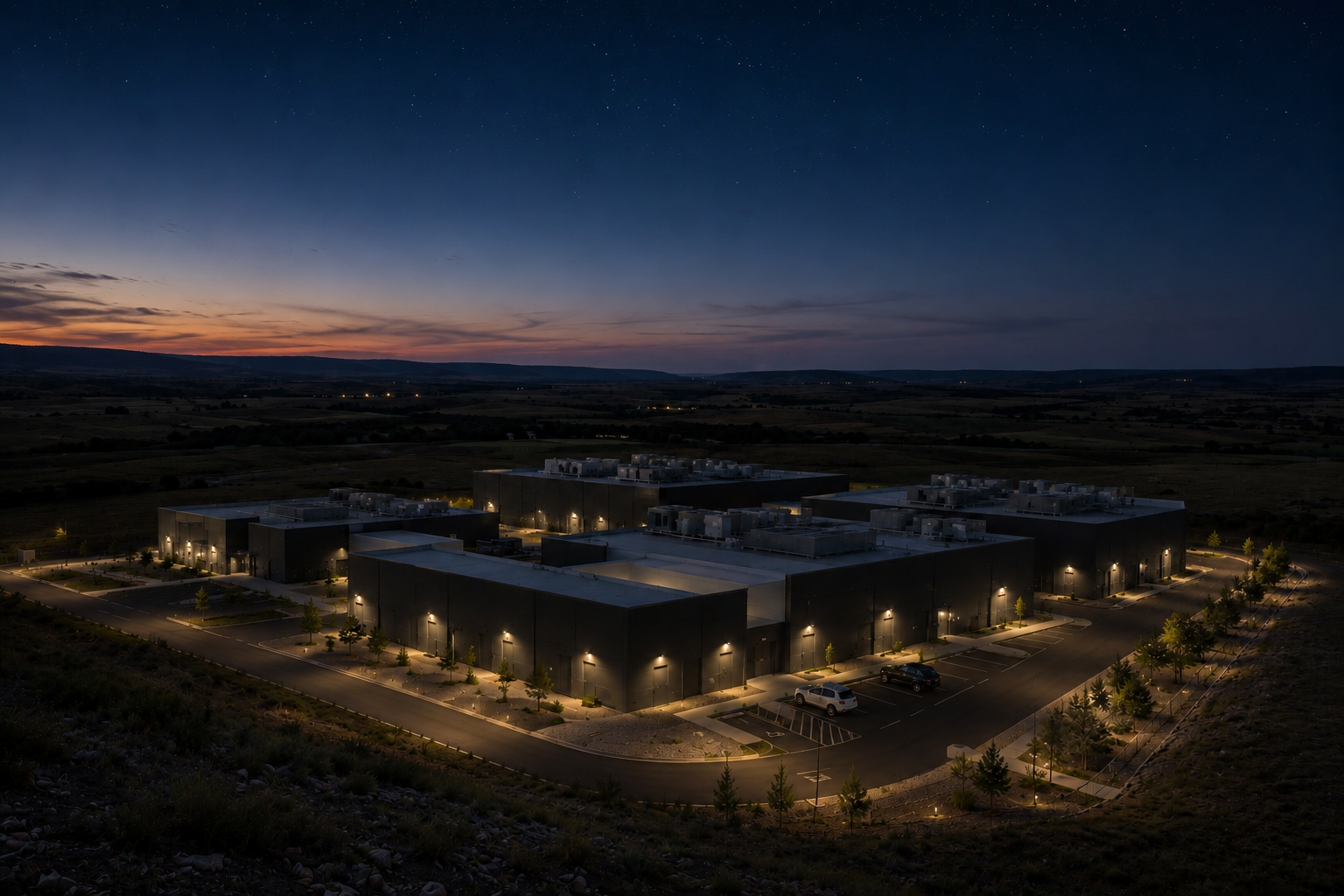
Our lighting plan is designed to be consistent with Dark Sky guidelines, meaning all exterior lighting will be shielded and directed downward to ensure light is cast only where needed.
Non-essential exterior lighting will be minimized or turned off during overnight hours.
Community Commitments
Shadowbox is not an outside developer. We have called DeKalb County home for nearly a decade. This project reflects our long-term commitment to this community.

A Decade of Investment
Shadowbox has been a fixture in DeKalb County for nearly a decade, operating a film and TV studio that has made Georgia's entertainment industry stronger.
As a long-standing DeKalb County corporate citizen, we have invested over $4.5 million in community benefits to date, spanning contributions to parks and trails to workforce training to food recovery partnerships and educational programs with local HBCUs and DeKalb County institutions.
Community Outreach
Shadowbox has conducted extensive community outreach on this project, including direct phone outreach, digital advertising to provide accurate information, and direct invitations to community members to meet and ask questions.
Those conversations have been productive. Shadowbox remains open to continued dialogue with anyone in the community.